














The Legacy of Regional Revitalization and Human Development (1)
-The Soul's Bridge Across Dokai Bay: Keitaro Yoshida and His Leadership-
Feature PICK UP 若松ゆかりの著名人
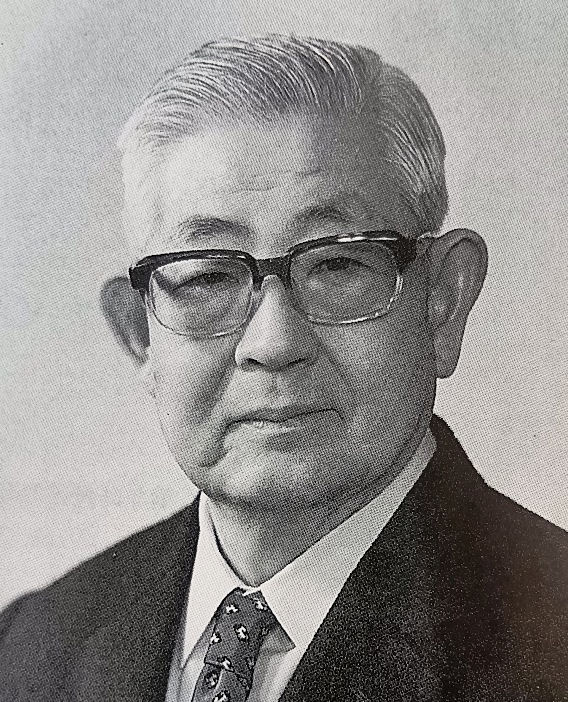
Keitaro Yoshida
When talking about the modern history of Wakamatsu, the achievements of Keitaro Yoshida and Asihei Hino mark a significant turning point. Keitaro's father, Isokichi Yoshida, was a major figure in the yakuza-politics world, known as the "Don of Western Japan." On the other hand, Asihei's father, the model for the character of Kengo Tamai in the novel Hana to Ryū (Flowers and Dragons), was a leader of port workers at Wakamatsu Port. These two men grew up watching their powerful fathers and inherited a "kawasujimon" bloodline—those who helped the weak and upheld righteousness. Despite their backgrounds, both had a strong desire to purify the local, folk energy of their homeland through intelligence, be it in education, governance, or literature.
The Consciousness and Struggle as the Successor to the "Boss"
Keitaro Yoshida was born in May 1899 as the eldest son of Isokichi Yoshida's younger brother, Jihei, and was adopted by Isokichi at a young age. He was raised as the legitimate successor responsible for the continuation of the Yoshida family line.
For Isokichi, who rose to political prominence with bravery and integrity, it was essential to cultivate a capable successor in order to grow the Yoshida group into a modern enterprise and political organization. He was determined to ensure that his heir was well-educated and cultured.
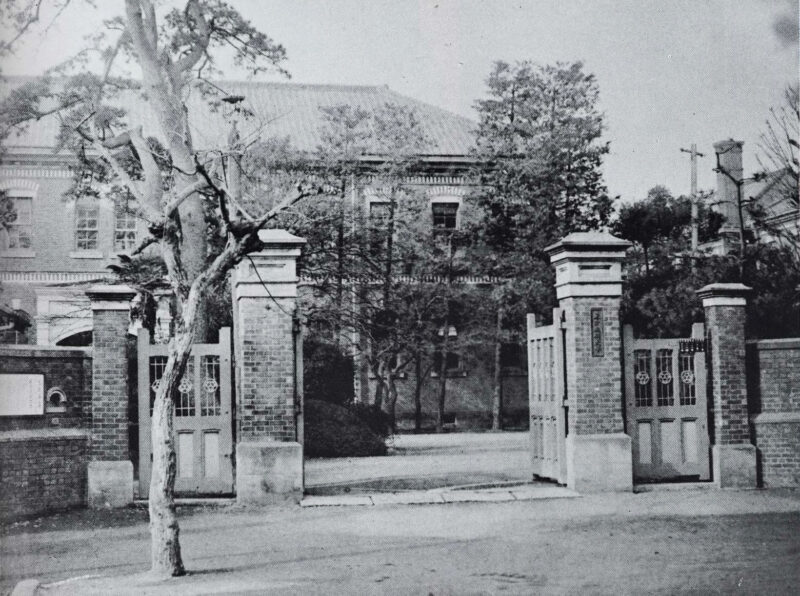
Keitaro graduated from Kokura Middle School (now Kokura High School), went on to Nagasaki Higher Commercial School, and later entered Tokyo Commercial University (now Hitotsubashi University), which was one of Japan's premier institutions for business and economics at the time. This decision reflected his father's aim to govern the coal-rich Wakamatsu not through the traditional yakuza dominance, but through modern economic and managerial power.
However, during his time as a student, Keitaro, in his formative years, became drawn to Christianity, a Western intellectual and ethical movement that had gained popularity among the intellectuals of the time. Exposed to modern moral principles and the Bible, he began to reject the rule by violence and vested interests, finding resonance in the Christian doctrine that emphasized the importance of individual conscience.
Entrance into Politics and Becoming a Pastor
After graduating from university, Keitaro joined Mitsubishi Mining and later worked as a lecturer at Ōkura High Commercial School. In 1935, he was elected to the Fukuoka Prefectural Assembly, marking the start of his political career. He was first elected to the House of Representatives in 1942.
However, as the defeat of Japan in the war approached, Keitaro sharply criticized the military-led cabinet of Prime Minister Hideki Tōjō. This led to his imprisonment in March 1945 by a special military tribunal. He was convicted and sent to Sugamo Prison, losing his seat in the Diet that same year.
His solitary confinement, however, became a turning point in his spiritual life. During his imprisonment, he was given a Bible and devoured its contents. The Christianity he had learned intellectually as a student became for him the guiding principle that would determine the course of his life. He realized that it was the only source of direction for his existence.
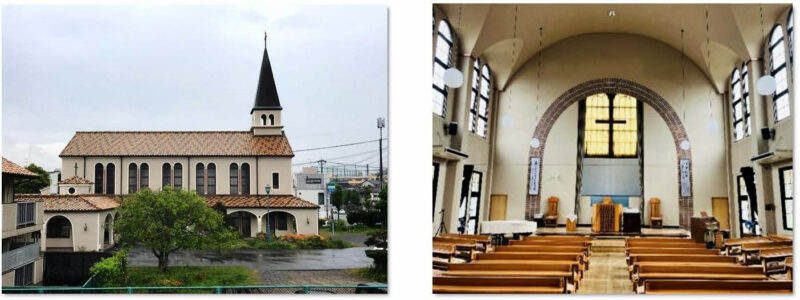
After being released from prison following Japan’s defeat in World War II, Keitaro returned to his hometown, was baptized, and in 1949, became the pastor of Wakamatsu Baptist Church. In his role as the mayor of postwar Wakamatsu, he transformed the image of the city’s leadership, based not on the traditional yakuza-like authority but on a new form of leadership founded on Christian principles—an experience of "kneeling before God."
Challenging the Construction of the "Wakato Bridge," the Greatest Bridge in the East
Keitaro Yoshida, who became mayor of Wakamatsu in April 1951, worked on various municipal issues over the course of three terms (12 years). Among these, the construction of a massive suspension bridge connecting Wakamatsu and Tobata was a national project that looked toward the merger of five cities.
The importance of a direct road connecting Wakamatsu and Tobata began to be discussed around the time of the ferry disaster in April 1930. In this tragic accident, over 70 people drowned, leading to discussions in 1936 about constructing a submarine tunnel between the two cities. However, with Japan entering the Pacific War, the prospects of this plan were dashed.
With the post-war economic recovery, the construction of a road directly connecting Wakamatsu and Tobata was revisited, and by early 1952, a promotional movement for the project was initiated by the two cities. After conducting geological surveys and comparing options for a submarine tunnel and a bridge, the superiority of a bridge was recognized from a comprehensive perspective, and the bridge construction was set in motion.
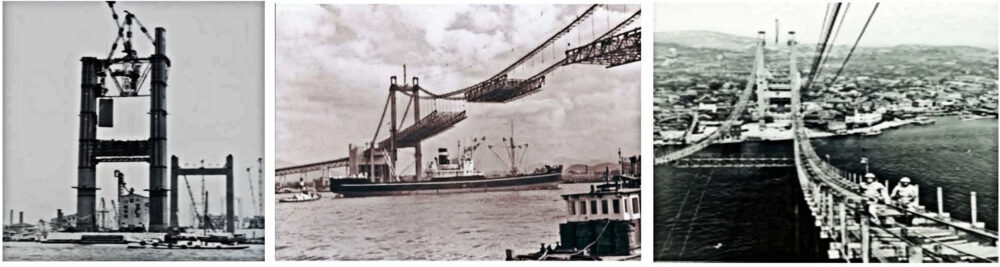
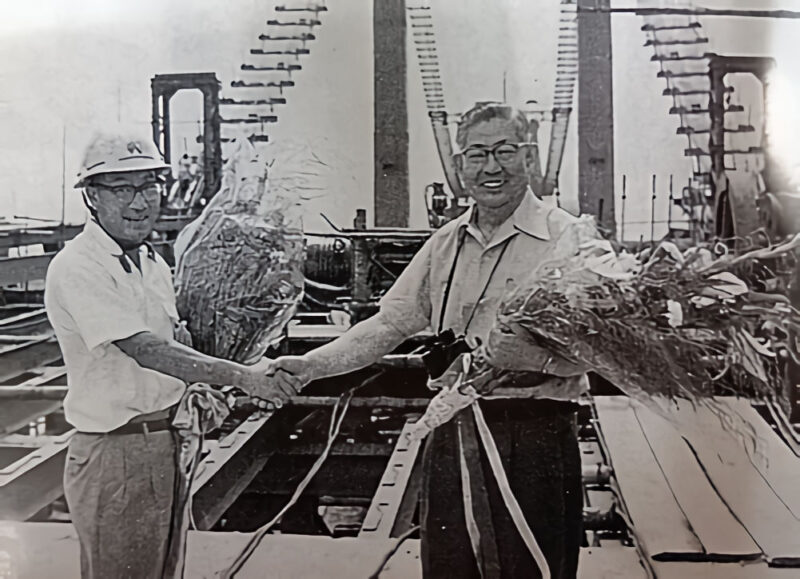
Over the next ten years until the completion of the bridge, Keitaro Yoshida faced a long and difficult struggle. The most significant challenge was how to secure the national budget of 5.1 billion yen required for the construction. Together with the mayor of Tobata, he made repeated trips to Tokyo to petition, and eventually succeeded in securing the entire budget. On March 31, 1959, the groundbreaking ceremony for the Wakato Bridge was held.
The Wakato Bridge, completed in September 1962, was named the "Wakato Great Bridge," and its grand opening ceremony took place on September 28. A massive red modern suspension bridge, once considered a dream, now spanned the entrance to Dokai Bay.
Commitment to Regional Development
When Keitaro Yoshida became mayor, the areas across Dokai Bay, such as Tobata and Yahata, were rapidly industrializing and urbanizing around the government-run Yahata Steel Works. Meanwhile, Wakamatsu's role as a coal export port was diminishing, and the only means of transportation was the inconvenient Wakato Ferry.
To break the economic and cultural isolation of Wakamatsu, he boldly used the term "an isolated island on land" and campaigned to convince both the government and citizens of the need for a massive bridge. After the bridge's completion, he emphasized that it was "the largest in the East."
This vision fostered a sense of pride among the citizens, who began to take pride in having "the largest suspension bridge in Japan and the East" in their town. The Wakato Bridge became a forerunner in Japan's development of long-span bridges, paving the way for later projects like the Kanmon Bridge and the Honshu-Shikoku Bridge.
In his later years, he reflected, saying, "The son of a yakuza became a pastor and served as mayor for 12 years, building the largest bridge in the East, the Wakato Bridge. My father often said that someone like me should not become a politician but should stay in my hometown and serve it. Yet, I have worked hard for the development of my hometown. Our region cannot develop without the efforts of the people living here."
In February 1963, the five cities of Kitakyushu merged to form "Kitakyushu City," the first designated city in Kyushu. After serving as mayor pro tempore for just over a month until the new mayor was inaugurated, Keitaro Yoshida retired from all public duties. He spent his remaining years as the pastor of Wakamatsu Baptist Church, guiding the growth of future generations. He passed away in July 1988 at the age of 89
60 Years of the Wakato Bridg